Go Back to What You're Great At

Craig Nielsen
February 20, 2026
You Don't Need to Become an AI Company
You Don't Need to Become an AI Company
You started your business because you're exceptional at something. Maybe it's logistics. Maybe it's financial services. Maybe you've spent fifteen years building deep expertise in healthcare, manufacturing, or retail. Whatever it is, that expertise is the engine of your business. It's the reason your customers trust you and the reason you win.
And then the AI wave hit.
Suddenly, everyone has an opinion. Your board wants an "AI strategy." Your competitors are making noise about automation. LinkedIn is full of people telling you that if you're not using AI, you're already dead. So you do what many responsible business owners do - you start exploring.
You watch the tutorials. You read the articles. You sit through vendor demos. You maybe even hire a data scientist or two. You spin up a few experiments. And before you know it, a significant chunk of your time, your budget, and your leadership attention is no longer focused on the thing that made your business successful. It's focused on trying to become something you never set out to be: a technology company.
This is the trap. Not because AI isn't valuable - it is. But because building, deploying, and maintaining AI systems is an entirely separate discipline. It requires different skills, different infrastructure, and different ways of thinking. Trying to bolt that capability onto your business from scratch doesn't make you innovative. It makes you distracted.
And distraction, for a growing business, is expensive.
The AI Landscape Is Deeper Than You Think
Part of the problem is that "AI" has become a single buzzword that papers over an enormous amount of complexity. When someone says "we should use AI," they're glossing over a stack of technology that runs from pure academic research all the way down to the software your team actually touches every day.
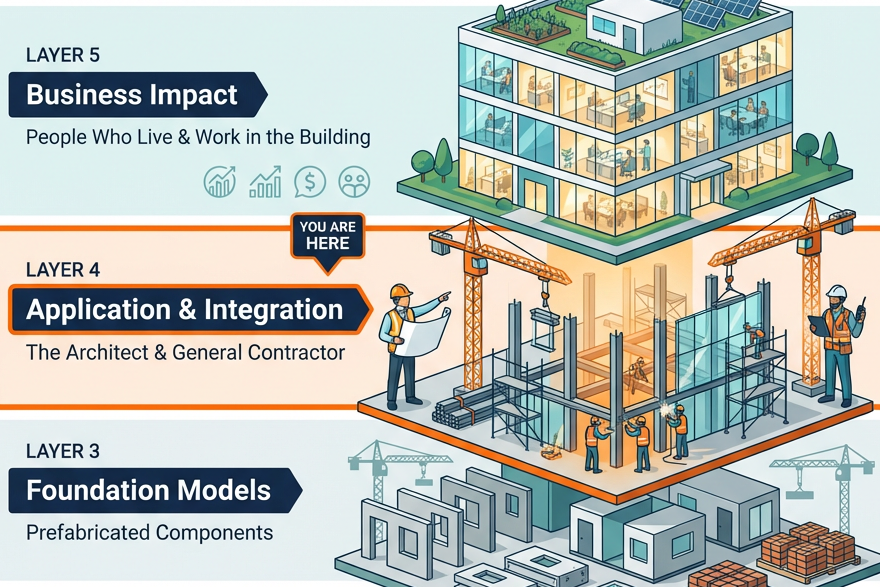
Think of it like construction.
When you walk into a modern office building, you see the finished product - the open-plan workspace, the meeting rooms, the lights that turn on when you walk in. What you don't see is everything underneath: the materials science that produced the steel, the quarries and mills that supplied the raw materials, the prefabricated components that were engineered off-site, or the architect and general contractor who turned all of those pieces into the building you're standing in.
AI works the same way. There's a stack, and each layer requires fundamentally different expertise.

The research layer
At the very bottom, you have pure research. Universities and labs like DeepMind and OpenAI's research teams are pushing the boundaries of what's theoretically possible. This is materials science — inventing new types of steel and concrete. It's essential work, but nobody at this layer is thinking about your invoicing problem.

The infrastructure layer
Above that sits infrastructure. The GPUs, the cloud compute, the data centres run by NVIDIA, AWS, Google, and Microsoft. These are the quarries and steel mills — producing raw computational power at massive scale. Your business doesn't need to buy a data centre any more than a restaurant needs to own a cattle farm.
The foundation models
Next come the foundation models themselves - GPT, Claude, Llama, Gemini, and dozens of others. These are the prefabricated building components: powerful, standardised, and increasingly available to anyone. They can do remarkable things out of the box. But "out of the box" is the key phrase. A stack of prefabricated wall panels is not a building. And a foundation model, on its own, is not a business solution.
This is where most people's understanding of AI stops. They see the foundation model, they're impressed by what it can do in a demo, and they assume the hard part is over.
It isn't. It's just beginning.
The application and integration layer

This is where our real work happens. This is the architect and general contractor — the layer where someone takes those powerful but generic model capabilities and combines them with your business logic, your data, your workflows, your compliance requirements, and your operational reality to build something that actually works. Reliably. At scale. In production. Not as a demo. Not as a proof of concept. As a system your team depends on every day.
This layer involves model selection, prompt engineering, data pipelines, testing, guardrails, monitoring, integration with existing systems, and ongoing maintenance. It's not glamorous. But it's where value is created or destroyed.
You wouldn't hand your employees a pile of prefabricated walls and say "figure it out." You'd hire someone who knows how to turn components into a functional building - one that meets code, serves your specific needs, and doesn't fall down six months later.
The business impact layer
At the top of the stack are the people who actually live and work in the building. Your team. Your customers. The end users whose daily work gets faster, easier, or more effective. The finance director who sees the ROI. This is the only layer that matters to your business - and every layer below it exists to serve this one.

You Don't Need to Build the Whole Stack
Here's the thing that nobody selling you AI wants to admit: the bottom three layers of this stack are commoditising fast. The models are getting cheaper, more capable, and more accessible every quarter. Having access to a foundation model is no longer a competitive advantage. Everyone has access.
The advantage lives in Layer 4 — in knowing which models to use for which problems, how to integrate them into real business workflows, how to make them reliable and safe, and how to do all of that without burning through months of experimentation and six figures of wasted budget.
That's what we do.
We don't build foundation models. We don't run data centres. We don't do AI research. What we do is live at the application and integration layer — the architect and general contractor level — and we build bespoke AI systems that solve specific business problems for our clients.
We find the right models. We design the right architecture. We handle the integration, the testing, the deployment, and the ongoing performance. And we do it so that you don't have to become an AI company.
Go Back to What You're Great At
The businesses that win with AI over the next five years won't be the ones that tried to do everything themselves. They'll be the ones that stayed focused on their core strengths and partnered with people who could handle the technology.
You don't build your own power station because your business uses electricity. You don't become a construction company because you need an office. And you don't need to become an AI company because your business can benefit from AI.
You need a partner who already understands the stack — so you can get back to doing the thing that made your business worth building in the first place.